
What Makes American Education Unique: A Deep Dive
Many families all over the world aspire to and strive for an American education for their children. That’s because American schools are well known for providing high-quality education through a balanced, tried-and-tested curriculum. In this article, we’ll examine what makes an American education unique and why it’s such an attractive choice for globally mobile families.
This post is written by XCL American Academy with contributions from the Think Global People Editorial Team.
Generally speaking, American education combines facts, figures and data with an open-ended, problem-solving-based curriculum that involves collaboration, trial-and-error methodologies and risk-taking. And it opens up students to unlimited opportunities, not only in the US but also globally.
Sending your child to an American school means they’ll learn the skills and confidence necessary to enter schools, colleges and universities in the United States or anywhere else. But how can you know if American education is right for your child?
In this article, we will address key inquiries about the American education system, such as its structure, objectives, and the reasons to contemplate it for your child.
How is the American education system structured?
Generally, the American school system is divided into four stages:
- Early Childhood Programme (Nursery to Pre-K) — 2 to 5 years
- Elementary School (Grades 1 to 5) — 6 to 10 years
- Middle School or Junior High School (Grades 6 to 8) — 11 to 14 years
- High School (Grades 9 to 12) — 15 to 18 years
A diploma or certificate is awarded to students who graduate from High School (Grade 12). From there, many students go on to college or university, which is referred to as higher education.
How is the American Education System Governed and Funded?
Unlike many countries, the United States does not operate under a single, centralised national education system. Instead, the American education system is highly decentralised, made up of more than fifty individual education systems. These include systems managed by each U.S. state and territory, as well as those overseen by organisations such as the Bureau of Indian Education and the Department of Defense Dependents Schools. While each system operates independently, there are many shared characteristics across schools.
What Types of Schools Are There in the US?
Education is delivered through a mix of public schools, private schools, and homeschooling, offering families a wide range of educational pathways. Educational standards are set at the state or territorial level by governing bodies such as state departments of education, boards of regents, or affiliated higher education institutions.
Funding for education largely comes from state and local governments, which together contribute the majority of education spending, while federal funding plays a supportive role. This structure allows flexibility and local accountability, while still maintaining consistent expectations across American schools both within the U.S. and internationally.

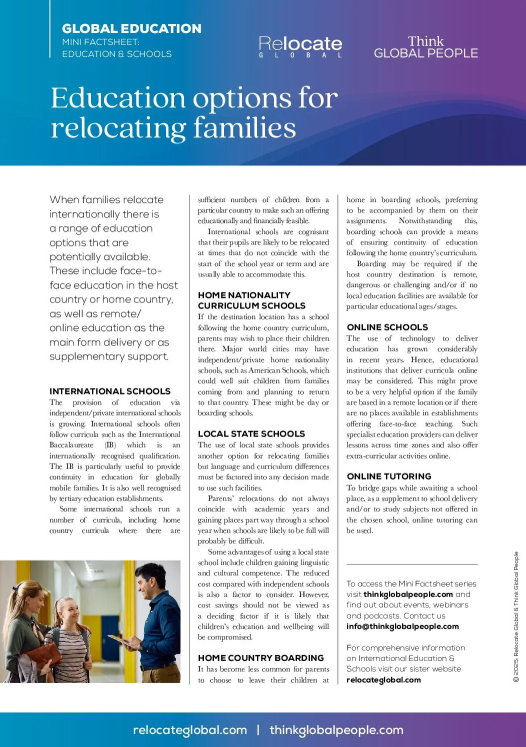
Education Options for Relocating Families
If you’re moving internationally and comparing different school systems, our Education Options for Relocating Families factsheet explores the main schooling choices available to expatriate and globally mobile families. You can download this factsheet here and explore the rest of our global education factsheets here.
How does the American Education Grading System work?
The American education grading system is designed to provide clear, continuous feedback on student progress rather than relying solely on high-stakes examinations. Most American schools use a letter grading system, typically ranging from A to F, with an “A” representing excellent performance and an “F” indicating that minimum requirements have not been met.
These letter grades are often paired with percentage ranges, helping students and parents easily understand academic achievement.
In addition to letter grades, many schools calculate a Grade Point Average (GPA), which reflects a student’s overall academic performance across subjects. GPAs are widely used within the American school system, particularly in middle school and high school, and play an important role in university and college admissions. Beyond grades alone, American education places strong emphasis on formative assessment, including class participation, projects, presentations, and coursework, encouraging students to demonstrate understanding in a variety of ways and supporting a more holistic view of learning and progress.
What Makes the American Education System Different from Other School Systems?
The American education system is distinct for several key reasons:
- Emphasis on critical thinking over rote learning
- Student voice, discussion-based classrooms
- Continuous assessment vs high-stakes exams
- Flexibility for transfers between schools and countries
Within the American school system, students are encouraged to question ideas, analyse information, and apply their knowledge in real-world contexts.
There’s a strong emphasis on critical thinking, problem-solving, and independent learning, rather than memorisation or rote recall.
Classrooms are typically interactive and discussion-based, giving students a clear voice in their learning and helping them build confidence in expressing ideas clearly and respectfully.
Another defining feature of American education is its focus on continuous assessment rather than reliance on a small number of high-stakes exams. Progress is measured through a combination of coursework, projects, presentations, and classroom participation, allowing students to demonstrate understanding in multiple ways. This approach not only reduces exam pressure but also supports a deeper, more sustained learning experience.
In addition, the flexibility of the American education system makes it easier for students to transfer between schools, states, and countries, as curricula and grading structures are widely recognised. This adaptability is one of the key reasons American schooling is so popular with internationally mobile families.

What are the Goals of American schooling?
A balanced approach to literacy
Balanced literacy is about balancing explicit language instruction with independent learning and language exploration. It aims to strike a balance between whole language and phonics when learning how to read and write. Critical phonics lessons are balanced with rich literature from around the world (especially the USA) that demonstrates creativity and thoughtfulness alongside the necessary phonics and literacy skills.

Everyday math skills
Everyday Mathematics is a comprehensive programme developed by the University of Chicago with over 30 years of research-based, authentic success throughout the United States. It has consistently been ranked as one of the top 10 academic mathematics programmes internationally.
Everyday Math uses a spiralling approach, which means concepts are repeatedly presented throughout the curriculum in other applications or with deepening levels of complexity.
This hands-on, spiralling curriculum meets each student where they are currently and continues to present skills and tasks throughout their Elementary and Middle School years. It builds solid, skill-based knowledge and various problem-solving methods, allowing students to learn and continue utilising it in high school and beyond.
Practical and authentic learning
American education emphasises practical, authentic learning that incorporates real-life lessons and activities. Programmes such as Discovery Works Science are designed to engage all students through virtual field trips, videos, podcasts, text, interactives and more that deepen students’ understanding of the lesson beyond mere facts and figures.
The curriculum allows students to demonstrate knowledge and skills obtained at each age and stage, including essential life-long skills such as leadership, collaboration, critical thinking, public speaking, data analysis and problem-solving. There is also an emphasis on authentic tasks, wherein students apply what they’ve learned to build products or solutions for real-life issues.
This rigorous academic programme is balanced by arts, music and sports instruction to develop students into well-rounded individuals.

Character development programme
More than just academic success, American education also focuses on students’ character development. For example, the Second Step programme offers a holistic approach to social-emotional learning (SEL) by providing a full scope of SEL activities and objectives from Kindergarten to High School.
The Second Step is closely aligned with the CASEL framework, which creates a foundation for applying evidence-based SEL strategies to schools and communities. Through guided lessons, discussions and activities, students develop key skills under the five CASEL competencies: self-awareness, self-management, responsible decision-making, relationship skills, and social awareness.
This character development programme aims to promote positive behaviour, global awareness, tolerance of others, and, above all else, kindness and empathy in students.
Why Choose an American Education for Your Child?
Rigorous and standards-based schooling
Rigorous educational standards such as the AERO Curriculum and US Common Core ensure students meet their academic goals in Mathematics, Science, Social Studies, English Language Arts/Literacy and other subjects. Plus, they allow an easy transition to any similar American curriculum worldwide.
University preparation
American education offers strong preparation for university by developing both academic ability and the independent learning skills students need to succeed in higher education.
Universities around the world are familiar with an American diploma. This gives your child plenty of options when choosing a university education.
Flexible and personalised learning approach
There are varied course pathways and subject choices which give students more opportunity to tailor their education to their interests and strengths.
International American Schools prepare students for a future in the US
If you’re choosing an international school, American education is the best choice for families who aim to live, study, and work in the US. It’s also a good choice if your child’s ambition is to head to the USA for further education.
Transferring schools can be stressful enough, so you can imagine how your child might feel when they move to the US or a different country. More often than not, academics are not the main concern, instead, many students worry about speaking up, making friends, and fitting in at school.
This transition is rarely easy, but it’s much smoother for students who come from American schools. They’re already familiar with the curriculum and find it easier to participate in class, especially in an American classroom setting where discussions abound and students are encouraged to think on their feet critically and logically.
American education also helps international students understand and harmonise with their classmates, who also come from diverse cultures and backgrounds. By acknowledging and incorporating this diversity into the curriculum, American schools help students develop the confidence and crucial skills to flourish in their new environments. Students are also less likely to feel alienated, which means they can adapt to their new life and school faster.
Whether your child is headed to the US or a different country, American schooling provides a strong foundation for success in an increasingly global world.
Discover an Authentic American International School in Singapore
XCL American Academy (XAA) international school, part of the XCL Education group, has operated successfully in Singapore since 2022. We offer an authentic American curriculum to enhance students’ academic and personal growth.
Our school is designed to offer excellent preparation for students planning to study, work and live in the United States and other parts of the world through rigorous academics aligned with American curriculum standards and a holistic approach towards character development and experiential learning.
We have carefully selected only the best curriculum programmes that have been tried and tested worldwide. In addition to closely following the rigorous AERO and the Common Core curriculum standards issued by the United States Department of Education, we adopt internationally recognised curriculum programmes such as the University of Chicago Everyday Math, Inspired Science, and a balanced approach to literacy with materials from Scholastic.
While we strongly emphasise what really matters – the rigorous academic programme – we also pay special attention to the social-emotional needs of the students in our care. A formal character development programme using the acclaimed Second Step framework has been embedded into the daily life of all students from Nursery to Grade 8 to help prepare them to become productive, caring, and creative global citizens. This character development programme aims to promote positive behaviour, global awareness, tolerance of others, and above all else, kindness and empathy.
One of the standout features of our curriculum is our unique PioneerTown programme, which focuses on entrepreneurship. Students participate in a large-scale simulation of a town, engage in role-playing and taking on different responsibilities in a self-contained economy, and learn important concepts such as economics, negotiation, innovation, leadership, sales, commerce, and many others.
Little by little. Day by day, students will develop the mindset and experiences they will need to be at the forefront of this change and to be agents of their own success. Contact us today to learn more about our curriculum, the American education system, and how we prepare students to become the pioneers of tomorrow.