
Education in Switzerland
Switzerland has always ranked as one of Europe’s best destinations for education. The choices include a highly rated state system, bilingual and international schools and an elite boarding school network.
Switzerland has always been a popular destination for the globally mobile thanks to its multicultural population, well-developed economy and spectacular natural environment.
According to the Federal Statistics Office (FSO), in late 2024, there were 2.368 million non-Swiss people living in Switzerland, making up more than a quarter of the total population. However, in 2024 immigration declined year on year by 15.6 per cent, with most immigrants arriving for employment with their families. The decline is seen by some as a balancing after several years of very high inward immigration, fewer Ukrainian refugees and a cooling labour market.
Most international families live in German-speaking Zurich, Switzerland’s most populous city, followed by French speaking Geneva. Expats love the quality of life in Switzerland, but it comes at a cost: late 2023/early 2024 figures from the Economist Intelligence Unit, Zurich tied for 1st place (with Singapore), and Geneva tied for 3rd place (with New York) as the most expensive cities in the world in which to live.
The Swiss state education system consistently ranks as one of the best in Europe, but in a multilingual country where four languages are spoken – French, German, Italian and Romansh (the latter is indigenous to Graubunden, the country’s largest canton), accessing it can be tricky for international families.
HOW THE SWISS STATE EDUCATION SYSTEM WORKS
Responsibility for compulsory education (between ages 6 and 15/16) lies with each of Switzerland’s 26 individual cantons. There is no national curriculum, but schools must meet objectives overseen by the State Secretariat for Education, Research and Innovation.
Most Swiss children (95 per cent) attend free state schools close to their home. Being bilingual is important and most children speak at least one second language.
“I advise expat parents with young children to start in the state system so their children can become fluent in German, and switch to private later,” says Stefanie Busse, founder of Zurich-based Swiss Education Consulting.
In Switzerland, early years education — prior to formal academic teaching — is Kindergarten from ages 4 to 6, where there is a focus on play and exploration. No formal reading or writing is taught before the age of 6 or 7. The emphasis is on play-based learning, social skills, independence and physical development. If your children are young, this early stage is the most successful time for expat children to fully immerse and acquire the local language (German, French, or Italian) before any academic work starts. However, if your child can already read at the age of 5 or 6, you might find this a frustration, and the system is quite rigid in this respect. Read one UK mother’s experience here.
The academic education system is divided into three phases: primary from age six until 12, followed by lower secondary which last three years. The end of lower secondary at age 15/16 is a crossroads for students: they can officially leave school but over 90 per cent go on to get an upper secondary qualification.
Upper secondary presents two options – a more academic general education or a vocational education programme (VET). The academic general education route prepares students for university via the Matura leaving certificate. Most students choose the highly regarded VET, a combination of learning in school and on-the-job.
What about the Swiss school Culture and teaching methods?
Taking German as a second language — Deutsch als Zweitsprache (DAZ) — is absolutely essential for children entering the Swiss state school system. The school system offers this excellent provision to their overseas arrivals. Children receive intensive German classes until they are able to take ordinary classes all subjects. Then they’ll just take one additional DAZ (German as a Second Language) class a few times per week.
Expat parents may find the Swiss teaching approach in general less communicative than systems in the UK or USA. Education consultants, Sandra Hueskes and Pascale Baumgartner explain:
“You’ll typically receive two class meetings per year, plus two parent/teacher meetings that will include your child. As for weekly updates or homework summaries? It doesn’t happen.” The emphasis is on professional trust: “Swiss schooling culture emphasizes trust and independence—for both the child and the parent.”
The streaming decision at the end of lower secondary (age 12 in some cantons, 15/16 in others) is a high-stakes event. A child’s placement at this point often determines their academic path (Matura/University or VET/Apprenticeship).
For an expat child arriving at age 10 or older, catching up to fluency in the local language to achieve the grades needed for the Gymnasium (academic track) can be extremely challenging, which strengthens the argument for choosing an international curriculum for older children arriving to live in Switzerland for a time. For further information see the About Switzerland website Education overview.
What expat families need to know about education in Switzerland
- The discontinuous school day
A major logistical challenge for working expat parents, especially those who don’t have a stay-at-home parent or live-in help, is that many state schools require children to go home for lunch (typically for 90 minutes to two hours). Supervised lunchtime care can be limited and an extra cost, which requires a parent to be home or a nearby caregiver to manage the midday break. - After school care
Generally school finishes by 4pm, so for dual working families, again this represents a typical childcare challenge and cost. If after-school care is important to you, then you need to choose your school and location carefully. Some gemeinden (after school care providers) offer subsidised after-school (and holiday) care, but others expect you to pay full price. - Watch out for Wednesdays!
One special quirk to the Swiss school schedule is that Wednesday afternoons are free—no school at all in many cantons. This has been in place since the 1970s when school used to also take place on Saturday mornings. - Clubs and activities
Unlike systems where schools host extracurriculars, most sports, music and non-academic activities in Switzerland are organized through external local clubs (Vereine). - Independent travel to school
Don’t be surprised to see children as young as five walking to school unsupervised. It’s hugely encouraged for kids to walk by themselves and to be “socially competent”, the latter is actually part of the grading system in school.
WHY INTERNATIONAL SCHOOLS SUIT THE GLOBALLY MOBILE
While standards are high in the state system, most expats choose international schools where lessons are taught in English and the education is transferable. International schools are also known for smaller class sizes and highly skilled teaching staff, which is attractive to expat parents, who want to support their children as much as possible in an international move.
According to ISC Research, in 2022 there were 103 English medium international schools in Switzerland educating 29,200 children between the ages of 3 and 18. Global data from ISC Research for 2024 indicates a growing market, but the specific, up-to-date numbers for Switzerland are not yet available.
There is a huge choice of curriculums and schools on offer, from American and British to Japanese and French, with fees for day schools hovering between CHF30,000 and 38,000 in the senior years.
“Switzerland has long had one of the largest numbers of international schools in Europe,” says Frazer Cairns, chair of the Swiss Group of International Schools (SGIS) which has 54 member schools across the country. “Families choose them for the opportunity to learn in English, skilled teachers, smaller class sizes and environments that value a holistic approach.”
Unlike in other parts of the world, Switzerland’s international schools are mainly patronised by expats, with fewer locals, says Nalina Cook from ISC Research. In some cantons, including Zurich, Swiss children are not allowed to attend international schools.
The last few years has been tough for some international schools and several smaller ones have been forced to close. “Companies are less prepared to pay for education, or they offer a limited package for two or three years,” says Swiss Education Consulting’s Busse. “After that some expats pay their own fees and others try and enroll in local schools, but unless children speak fluent German it is hard to switch.”
Schools in Zurich
Zurich is Switzerland’s largest city has a population of 434,000 (2023 data), about 32 per cent of which is international. The city is one of the most important financial centres in Europe with a growing fintech hub and home to the Swiss stock exchange and global Swiss companies such as UBS, Swiss Re and Zurich. A 2023/4 report by Canton of Zurich Department for Economic Affairs Office for Economy and Labour, states that Zurich’s financial hub employs over 97,300 people. According to the report:
“This corresponds to 42 per cent of jobs and 45 per cent of gross value added of the Swiss financial centre as a whole.”
Zurich has plenty of good state schools, but teaching is in Swiss-German, making it inaccessible for many international families, who often prefer the city’s international schools. With more than 20 in the city and surrounding area, there is plenty of choice.
“Parents ask me which schools are the most academic, but it is impossible to answer,” says Busse. “The most established offer a solid education but because the student body is diverse, and many do not have English as a first language, schools can have good results one year, but not the next. It depends on the cohort.”
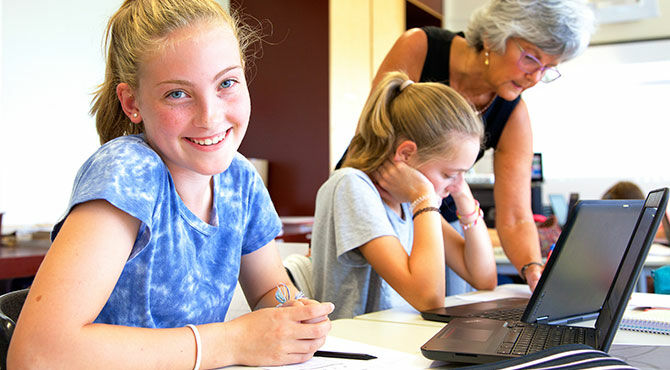
The Inter-Community School Zurich
One of the biggest is Zurich International School, based on three campuses and educating more than 1300 students per year aged between three and 18. Around one third of pupils are from the UK or US, lessons are in English and most study for the IB diploma. Founded in 1963, the school recently opened a new middle and upper school campus with swish facilities including a new media centre, two concert halls and expanded sport facilities with an indoor gym and full-size pitch.
The Inter-Community School (ICS) Zurich is the oldest international school in the Zurich area, founded in 1960, and the only school in Zurich offering a through school IB education including primary, middle years and the IB diploma to roughly 800 students each year.
For students seeking a British education, the International School Zurich North (ISZN), part of the global Cognita Schools Group, was established in 1999. It offers IGCSE and A levels, alongside the IB diploma.
Hull’s School, founded in 1945, also has a curriculum based on IGCSE and A levels, educating 400 teenagers from Years 10 to 13. Most of the students are native German speakers and Swiss nationals.
For bilingual children the SIS Swiss International Schools Group has eights school in Switzerland including four in the Zurich region providing a K-12 bilingual education in German and English. At the Swiss International School in Zurich students graduate with either the Swiss Matura or the IB diploma.
Schools in Geneva
French speaking Geneva is Switzerland’s second largest city with a population of 206,600 (2023 data). Around 40 per cent come from outside Switzerland, representing 189 nationalities. Many work in the city’s financial centre or in one of the UN organisations that have headquarters in the city, including the World Health Organisation. According to Geneve Internationale the city is home to 40 international organisations and 476 NGOs which account for one in ten jobs.
The financial centre also has many international employees: according to the Geneva Financial Centre, the umbrella association for the financial sector, there are over 80 banks in the financial center and over 38,000 people work in banking and finance.
With around 18 international schools in Geneva, families have plenty of choice. One of the best known is the International School of Geneva, known as Ecolint, which educates 4000 students across three campuses incorporating 140 nationalities. Founded in 1924 by civil servants from the International Labour Organisation and League of Nations (the forerunner to the UN), it was the world’s first international school. It is also the birthplace of the IB diploma, developed by Ecolint teachers in the 1960s. Students are encouraged to be bilingual and can study for either the IB, IGCSE and A levels or the IB diploma.
The College du Leman is popular with students from the US. Part of the Nord Anglia Education group, it is a bilingual K-12 day and boarding school with 1900 students and delivers a range of curriculums leading to the American high school diploma, the IB, Swiss Matura and the French Bac. Most graduates go on to university in the UK, Switzerland and the US.
For families looking for a K-12 British curriculum, students at the Geneva English School (GES) study for IGCSE and A levels on two campuses at Genthod and Versoix, just outside Geneva.
There are good international options elsewhere in the country including Lausanne, Bern, the Swiss Alps and Basel. The International School of Berne opened in 1961 and moved to on a new purpose-built campus in 2017. It is the only internationally-recognized English language school in the canton, and the only to offer a through-train IB programme. It also offers a distance learning option and the ISBBerne Diploma, an accredited American high school diploma.
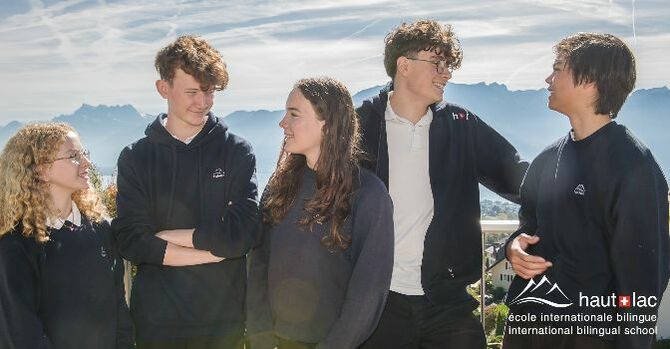
Haut-Lac International Bilingual School
The International school of Lausanne also offers a through-train IB education across four campuses and nearby Haut Lac International bilingual school opened in 1993 providing a K-12 truly bilingual English/French education leading to the IB diploma.
Swiss Boarding Schools: The Elite Choice
The strongest growth in the Swiss international education market is in the country’s elite boarding school network, charging premium fees and delivering a personalized education alongside a luxe selection of extra-curricular activities which might include skydiving, ski touring and sailing. Fees are steep – upwards of US$120,000 and according to ISC Research, they attract the wealthiest families particularly from Russia, USA and Asia.
The economic and political landscape has changed in the past decade, with the war in Ukraine, but in spite of this, one 2024 case study shows that expensive Swiss boarding schools aim to appeal to a globally wealthy clientele and at the case study school, Russians were still noted as the most-represented nationality.
“These boarding schools have seen record numbers of new enrolments and admissions enquiries,” says Cairns.
They include the TASIS American School in a spectacular mountain setting overlooking Lugarno, part of a group of international schools with campuses in the UK, Puerto Rico and Portugal. It was the first American boarding school in Europe, founded in 1956, and with students from over 60 countries and delivers an IB curriculum.
One of the most exclusive schools in the world is the Institut auf dem Rosenberg in a beautiful parkland setting in German speaking town of St Gallen, around one hour from Zurich. Founded in 1889, With only 230 students, and an average class size of eight and student staff ratio of 1:2. Its co-curricular activities include wealth creation and investment and diplomacy and leadership. In late 2023/early 2024, the full-board fees are often cited as upwards of CHF 165,000 (approximately $175,000) and remain among the most expensive in the world.
Others include Le Rosey, on the shores of Lake Geneva, where students move to the school’s second campus in Gstaad for the winter term to allow for daily skiing. Le Rosey also acts as a mentor to its sister school, Le Regent, the newest international boarding school which opened in Crans Montana in heart of Swiss Alps in 2015.
Others in the exclusive Swiss boarding network include Brillantmont International, in Lausanne, founded in 1882 and the oldest family run and owned international school in Switzerland; The College-Alpin Beau Soleil in French speaking Villars-sur-Ollon surrounded by spectacular view of the Alps; Aiglon College in Chesieres and the Lyceum Alpinum Zuoz near St Moritz.
Summing up: Educational Choices for families relocating to Switzerland
Switzerland offers an outstanding range of educational options for expats and making the choice between the free, high-quality local state system and the fee-based international system depends heavily on your family’s long-term plans, your children’s ages and logistical needs.
The most crucial advice is to align the family’s expected duration of stay with the child’s age.
Ages 4-7 (Kindergarten/Early Primary): for most early years pupils, state school integration and free language fluency is a viable option.
Ages 8-10 (Mid-Primary): again for children with no special needs, a bilingual or state school option is absolutely suitable, as acquiring the language quickly is still manageable, but school day and after-school logistics do become more of an issue if both parents are working full time.
Ages 11+ (Late Primary/Secondary): at this age, an international school because much more attractive since the local language gap makes the academic Gymnasium track a severe challenge and education transferability is paramount.
This then needs to be weighed up along with your family needs, the length of your work assignment, any educational provision in your relocation package, and your particular location in Switzerland including the local options available. You can start looking at our Featured Schools in Switzerland here. Good luck!