International School of London: How Multilingual Education Shapes Empathy, Leadership and Future Success
International School of London (ISL) has long been recognised for its vibrant international community. With families arriving from every corner of the globe, ISL has built an environment where students feel seen and valued from the moment they arrive. This sense of belonging stems from intentional practices including a supportive family ethos and a multilingual education model that values every child’s language and identity.
During a recent webinar, Nurturing Global Excellence: International School London’s Multilingual Model and Culture of Care school leaders at ISL shared how multilingualism contributes to a culture of empathy, helps develop leadership skills and drives academic success. At ISL, language learning is both a tool for self-expression and a pathway to understanding others.
With more than 24 home languages taught, and new ones added whenever a student needs it, the school’s multilingual programme is central to its mission of shaping globally minded, confident and compassionate young people.
Multilingualism and Diversity as a Strength
From the moment families join the school, ISL positions multilinguism and diversity as a strength. Many students arrive after living in multiple countries, and instead of viewing this as a transitional challenge, the school sees it as an asset.
.Claudine Hakim, Head of Community Engagement, Transitions Care and Student Support explains, “We have families from all over the world… and instead of seeing that as a challenge, we see it as an opportunity,”
This outlook is reinforced through strategic transition-care programmes, strong parent–school partnerships, and a staff body representing a wide range of cultures and nationalities.
There’s a genuine belief that our differences become our commonality, and that’s what really connects us”
Claudine Hakim, Head of Community Engagement
How ISL Embeds Belonging: Intentional Practices and A Warm Culture
Students are encouraged to contribute to this ethos through active voice and participation. Families are continually involved and are an important part of the school community. The school’s warmth and openness are paired with deliberate choices in curriculum design and pastoral care, ensuring that a sense of belonging is consistently reinforced. Claudine believes that one element, in particular, is crucial to making this possible: “I would argue that our renowned multilingual programme is a key component in ensuring that this happens.”
The Multilingual Advantage
This emphasis on multilingualism is led by Zach, ISL’s Head of Multilingualism, who oversees a programme that currently includes 24 home languages. The goal is ambitious yet simple: to ensure that every student’s linguistic identity is valued. “Our promise is: whoever you are, whatever your level of fluency, we find a teacher for your repertoire” explains Zach. If a new student arrives with a home language the school has never taught before, it’s Zach’s job to source a teacher specifically for them.
This commitment means that students’ language and by extension their identities “stay alive” even while living abroad. Learners can continue developing their home language, acquire English, and often explore additional languages. Zach notes, “Some students might be learning three languages or even four languages at the same time.”
The programme is rooted in the International Baccalaureate (IB) philosophy, which emphasises maintaining home languages alongside developing new ones. Through IB Language A (Language and Literature) and Language B (Language Acquisition), students encounter literature, poetry, creative writing, grammar and spelling, but ISL goes further. What makes the school’s approach distinct is the way multilingual learning is deliberately interconnected. “What you are learning in your home language links very carefully into other language subjects and also into non-language subjects,” says Zach. This cross-curricular alignment strengthens literacy and creates a coherent learning experience across disciplines.
Ultimately, multilingualism at ISL is embedded in the school culture. By valuing each student’s linguistic identity and building bridges between languages, the school fosters both academic achievement and a profound sense of belonging. As Zach summarises, this integration is “fully embedded into what we do.”
How ISL’s Multilingual Community Shapes Wellbeing
For ISL, wellbeing is the emotional foundation that enables students to learn and connect. As Middle School Counsellor, Timea Virag, explains, the school sees itself as “a village, like a global village… and don’t they say it takes a whole village to raise a child?” Supporting globally mobile students also requires that every child has the language and emotional tools to express how they feel during periods of upheaval or transition.
Timea notes that international students often speak multiple languages, sometimes two home languages and may struggle to articulate complex emotions while adjusting to a new country or school. “How can they be happy if they don’t have the language to explain what is going on for them?” she asks. Her counselling role is built around giving students “the space to be open to conversations around their story,” whether they are grieving the loss of friends left behind, feeling culturally disoriented, or simply navigating the uncertainty of starting over.
This holistic wellbeing approach spans admissions, student support and pastoral care. As Timea put it, the team works collaboratively and with an awareness of their own identities and backgrounds to create “a more nurturing space where students really belong.”
Supporting Students Through Life’s Transitions
A key part of ISL’s ethos is its structured approach to mobility and change, recognising that families may arrive, stay for a few years, and eventually move on again. The school actively uses the language of “Arrivers, Stayers and Leavers” to help students locate their place in the cycle of transition. This may seem simple, but it has profound psychological value.
“Positive transitions care is embedded in recognising: are you an Arriver, a Stayer or a Leaver?” Tamia explains. From the very beginning, new students receive additional nurturing support, and families are included too. ISL runs workshops on topics such as Third Culture Kids (TCK) to empower parents and children with tools to navigate identity, belonging and emotional resilience.
Throughout the year, students come together across grades for check-ins, storytelling and small-group sessions. These moments allow them to reflect on their own journeys. Discussions cover topics such as how many countries they’ve lived in, what they miss, what excites them and to listen to each other with empathy. “If I could take a picture of the faces of the students when they have the opportunity to share, to be heard, to be seen… it is the most empowering feeling,” Timea says. These practices help children strengthen their “roots,” giving them confidence as they grow into self-aware young adults.
If I could take a picture of the faces of the students when they have the opportunity to share, to be heard, to be seen… it is the most empowering feeling”
Timea Virag, School Counsellor at ISL
Expanding Multilingual, Transistion and Wellbeing Programmes
ISL’s innovative approach to transitions, multilingualism and wellbeing has evolved over more than 15 years. But the school continues to refine and expand its programmes.
Claudine explains that ISL’s work is grounded in its long-standing membership of Safe Passage Across Networks (SPAN), an internationally recognised organisation specialising in positive transitions care and attachment security. This partnership has shaped ISL’s culture of mobility support and informed its evidence-based programmes. “Having access to experts in the field… gives us that foundation,” she says.
One recent innovation is ISL’s Life in London Acculturation Programme for parents. This initiative helps new families understand life in the UK not to assimilate, but to engage confidently while still valuing their own cultural identities. Pre-arrival communication, clear routines and early relationship-building help reduce anxiety long before a child sets foot on campus.
Building Community for Parents through Language Learning
While ISL’s PTA is active, the school recognised that some parents felt unable to fully participate due to limited English proficiency. In response, Zach and the multilingual team launched free English classes for parents, which have been great for building community.
Now running two weekly group, one beginner, one advanced, the classes attract up to 40 parents each week. Zach adds, “They are a very cosy community”. Although language development is the formal purpose, the true impact goes far deeper: friendships form across cultures, parents gain confidence and families feel more connected to school life. The classes also help parents understand the curriculum and local culture, creating what Zach describes as “a complete loop of understanding.”
What Other Schools Can Learn From INternational School of London
When asked what other schools could take from ISL’s approach, Claudine is clear: everything begins with belonging. “Every relocation, every move, begins with the need to belong,” she says. If students feel connected to peers, teachers, and culture then they can learn and thrive.
She also highlights the importance of personalisation: “No two kids are the same. No two families are the same.” ISL works with each family from the moment they enquire, through their arrival, their years at the school, and even after they leave, many returning as engaged alumni. This long-term relational approach is central to the school’s identity.
developing Global Citizens Through Empathy and Multilingualism
The combination of multilingual education and the IB curriculum creates what Zach describes as “internationally mobile, competent leaders.” Belonging, academic rigour and cultural insight intersect to help students develop empathy, emotional intelligence and confidence across cultural settings.
“They have empathy through transitions… empathy through multilingualism… empathy through multiculturalism,” he explains. These qualities prepare ISL students not only for university and careers, but for life in an interconnected world. They leave the school as adaptable, culturally fluent global citizens.
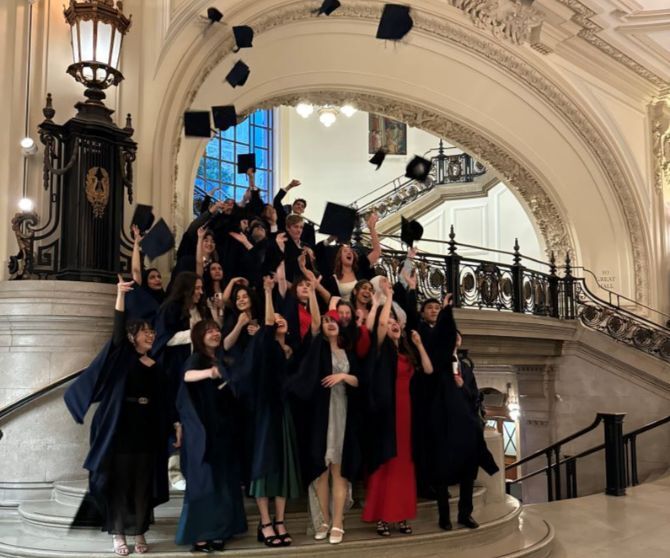
Think Global People Relocate Award Winnner – Excellence in education
In recent years, ISL has received multiple awards for excellence in education including top honours from Relocate Global and Think Global People. But the school sees these achievements not as endpoints, but opportunities to reflect and improve.
Claudine notes “Each time we apply for an award, it forces us to stop and reflect.”
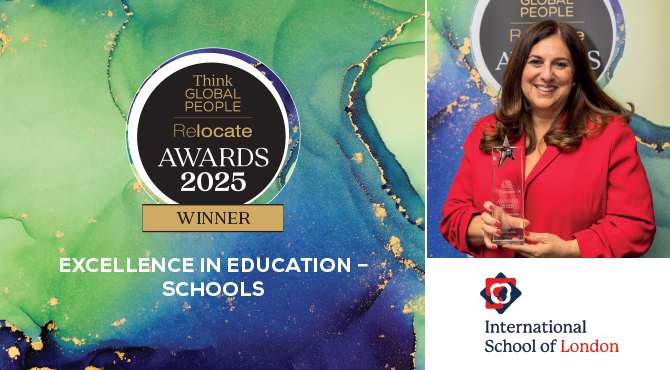
International School of London – WINNER SCHOOLS
With more than a decade of ongoing development, the team continues to refine its practices while staying true to its core mission.
“You don’t climb a mountain in one go,” she reflects. “Each step takes us to the peak.” She credits the school’s success to passionate staff, deep collaboration and a shared commitment to caring for the whole community.
Watch the webinar : International School of London