Think Women
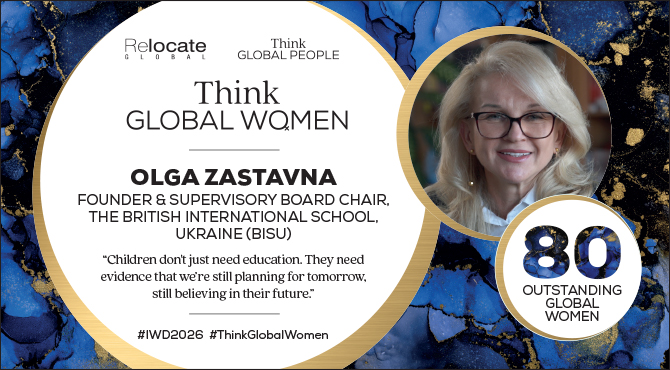
Olga Zastavna | 80 Outstanding Global Women 2026
It has been four years since the full scale invasion of Ukraine and the doors of The British International School, Ukraine (BISU) remain open. A place where students not only survive but thrive under Olga’s inspiring leadership.
‘My whole life has been connected with education, being around children and educators. I can’t imagine ever doing anything else. An alternative does not even come to mind.’
Olga started her long career in education after graduating from the Pedagogical Institute of Foreign Languages in Ukraine.
“I worked as a lab assistant, then became a lecturer. It was a very prestigious job at that time. I was teaching Russian language to international students and English for beginners. I then started lecturing for seven years. I really enjoyed it and was very successful as a teacher. I was quite a young lecturer and had adult students from all over the world. I remember spending lots of time preparing for lectures to bring students something new and informative and they were so appreciative. I was deeply involved in teaching and seeing the results really inspired me.”
Natural born educator
In 1994, Olga opened her first language school. At that time there was huge competition in Kyiv and she remembers it proudly.
“I still remember my first team there, because I managed to create such a wonderful and enthusiastic team of teachers. At that time I was a teacher, a secretary, running many heads of departments, and a director. Our Monarch Language Academy became extremely successful and we had a huge waiting list for students. We were young, enthusiastic, and very successful.”
As well as being an innovative language school, it was the first-ever to introduce teaching English from beginners to upper intermediate levels in Ukraine.
Busy making her mark as a bold education leader, Olga later met with Nord Anglia founder, Kevin McNeany.
“He had already opened a lot of schools across Eastern Europe and was a pioneer, having started schools in Eastern Europe. At the time, he had schools in Moscow, Prague, Bratislava and Warsaw. Ukraine was on the agenda and so we met. We invited him to visit us. His career had started with a language school too, and in 1997 BISU in Kyiv was born.”
You could say BISU has been her life’s work, now in its 29th year. “It is such a creature. It’s a mechanism. It’s a family – and it requires all of your attention.”
For a good while, Olga was managing several components of the school. “I was the director of the school, the manager, the local partner – we were all growing this school together and growing with it.”
Starting with 60 children in 1997 by the end of the same year BISU had more than 120 students and keeps growing today. In 2001, a smaller sister school in Dnipro was opened. A school that now sits just 60-70 kilometers from the front line of the war and which runs as an offline and online school taught by international teachers alongside Ukrainian teachers.
“This year we managed to appoint three more international teachers to teach offline. Frankly, I don’t know how we managed to do that,” she added. A testament to what BISU has become and the loyalty and draw it has for both Ukrainian and international educators.
“We’re very proud that we’re the first international school who has brought British education to Ukraine. We’re the only school who have been operating from day one of this big war.”
The school has a history of facing hard periods. “We have gone through a couple of difficult pages of our history. We overcame the Orange Revolution in 2004, a period that was not so severe as now but very challenging – a difficult revolutionary period. In 2014, we had another challenge, and the biggest one which we are still fighting now since 2022. On top of this, we’ve just had the hardest winter. Through it all, we are the only international education institution who has not closed. We’re still here and I’m extremely proud of my staff and the team.”
Both BISU’s schools in Kyiv and Dnipro now currently have their largest number of international teachers from across the world.
“We have teachers from the UK to Australia, US and Canada. Working face to face and shoulder to shoulder with Ukrainian teachers. This gives me so much motivation as a leader because it shows they believe in the school and they believe in the children. They know they’re coming here not just for a job but a mission – one that we all share.”
Courageous leadership
Leading an education organisation through wartime takes spirit. For Olga it’s not just about delivering education, she has built a sanctuary too. A place that offers safety, support, security and hope. So much so that parents often tell her they feel their children are so much safer when they are learning at school.
“When the war started none of us had the experience of how to cope or proceed. The first few days were the most difficult ones when we needed to organise an evacuation process. My leadership team demonstrated great resilience and courage and unbelievable organisation.”
She thinks back to when her team had to evacuate all the international teachers who were far from home. Not an easy undertaking.
“We prioritised evacuating international teachers alongside their cats and dogs and everything that was important to them and managed to do it successfully and professionally. I think that’s why – as soon as it was possible – many of them decided to come back to BISU because of the belief and trust they have for management, the school and our children. I think that’s the most important thing. The belief we all share is what motivates me to keep going.”
Pausing to reflect what her team have been through, she recalls her teachers giving lessons in shelters on the eve of exam week to ensure students were fully prepared for their tests.
“Hope in our situation is not only about confidence. You have to believe at the back of your mind that you will be able to cope and that the future of tomorrow is going to happen. If you deeply believe it, you demonstrate it. As a role model for your staff you have to show up – stay focused, organised and committed.”
Olga is a believer of behavior modelling. “When you demonstrate that belief, people around you automatically get motivated. They pick up on it and feel it.”
“Children don’t just need education. They need evidence that we’re still planning for tomorrow, still believing in their future.”
Olga Zastavna, Founder and supervisory board chair
The British International School, Ukraine (BISU)
Educating to inspire
In times of war, you’d expect standards to be lowered but Olga was determined that the quality of education remain high and consistent to give all students the best start possible.
BISU offers a comprehensive Cambridge Pathway for all age groups starting from early years and advancing through Cambridge IGCSE, A Level and the IB Diploma Programme. Additionally, local students have the option to follow the Ukrainian curriculum.
“Our students need the Cambridge Pathway delivered with the same rigour, the same expectations, the same belief in their potential that we would offer in peacetime.”
Under her leadership, BISU has continued to invest in SEND learners and areas such as personalised education. Student wellbeing and care is another major aspect of BISU which stems from a place of empathy and openness. The schools also offer students everything from grounding to art therapy to help relieve anxiety and voice emotions as well as SEND rooms.
“Children don’t just need education. They need evidence that we’re still planning for tomorrow, still believing in their future.”
When asked what motivates her in these times of uncertainty, she says: “I think it’s very simple. You have to be in love with what you’re doing.”
The British International School Ukraine’s featured school page