

Wellbeing in business: How to help teams manage stress and prevent burnout
For many employees, the modern workplace feels more pressured than ever, with rising levels of stress at work and increasing cases of employee burnout.
With the opportunities of hybrid working and the time-saving advances of technology and Artificial Intelligence (AI) employees should in theory have more time to spend on more pleasurable and less mundane aspects of working life.
In practice, workloads have intensified and boundaries between work and home life continue to blur.
Businesses are under growing pressure to implement effective workplace wellbeing strategies that support both productivity and mental health.
The recent Health and Wellbeing at Work report by the CIPD revealed record levels of sickness absence in offices around the UK which were the highest in 15 years. It found that nearly nine million working age people live with work limiting health conditions and warns that as people continue to live and work longer, organisations must adapt to support them effectively.
Stress isn’t the enemy. What if we were to think of it as data?”
Amy Brann, Founder and Director of Synaptic Potential
What Causes stress and burnout in the office?
Many workplaces are under pressure because of heavy workloads and economic pressures.
Employees are having to negotiate complex people dynamics, organisational shifts, and constant change in an environment which feels more uncertain and fast-moving.
Jenny Roper, editor of Work magazine, produced on behalf of the CIPD, opened the conversation on wellbeing at work with a session at the CIPD conference focused on managing stress and burnout. The session entitled Thrive, don’t just survive, explored the challenges faced by managers who have responsibility for many areas of the business while also trying to care for their own mental and physical health.
Joining her was Beatriz Fuentes, a people leader with over 20 years of experience spanning healthcare, technology, manufacturing, and the charity sector, and a Fellow of the CIPD, and Amy Brann, founder and director of Synaptic Potential, who explained the science and practice of managing stress and building resilience.
Understanding Stress at Work: When Stress Becomes Burnout
Brann opened her session by challenging conventional narratives around stress. She explained that the biological processes associated with stress and the production of adrenaline and cortisol are normal and can be beneficial. The problem arises when stress becomes chronic and unmanaged.
“Stress isn’t the enemy,” she said. “What if we were to think of it as data? If we are in a state of stress, experiencing stress, then it could be our body saying something matters here, something is important”.
Micro recovery Techniques to Reduce Stress at Work
Brann suggested practical solutions based on neuroscience, emphasising “micro recovery” techniques that can shift physiological and cognitive states in a matter of minutes, such as taking a short break to take deep breaths to calm our nervous systems. “Even 90 seconds of slow breathing can affect our cortisol production,” she explained.
“Taking a short break or getting out into nature are amazing for this. In addition, what we call social buffering, a quick positive interaction with someone else, just two minutes of genuine connection, measurably lowers our stress hormones.”
She said the focus should be on small, regular actions rather than storing it up until breaking point.
“Managing stress daily is the biological maintenance we need,” she said. “We cannot wait for an annual holiday. Those two-week breaks are really good and really important, but they’re not enough to keep us well and in peak condition. We have to check on a daily basis that things are as they need to be, rather than wait and save it up.”
Building Resilience at Work: Why Recovery Matters More Than Endurance
She also described the concept of resilience being less about enduring and more about recovering better. Planning for sleep, reflection, and connection increases productivity and reduces the risk of burnout, but it is something that we need to cultivate before a crisis hits, as it is hard to be resilient in the middle of extreme demand.
“It’s a neural process. There’s a lot of energy that goes into rewiring the brain to be more resilient, so it’s something that we strategically should be considering and building in before a crisis occurs,” she said. “There are always things that happen outside of our control, but essentially, we want to be charging our battery before it dies. My question for you is, what is building your energy, and are you treating it as optional or essential?”
She explained that building resilience should be part of our daily strategy, so that when we do face tough times, we have a toolkit to use.
“If we want more of something, if we want to be better at something, then we likely need to be strategic about it and start investing in it,” she said.
How expectations contribute to stress and burnout
Brann highlighted the critical role expectations play in wellbeing. A heavy or unreasonable workload is often blamed for burnout, but she explained that the demands that we place on
ourselves, and the external pressure from others in the organisation, can also be significant contributors to stress and burnout.
Burnout isn’t a weakness. It’s an indicator that your capacity has been exceeded for too long. That battery is at 5%”
Beatriz Fuentes, Managing Director, Springs People
“One of the hidden drivers of burnout isn’t workload so much as expectation, expectations of workload, the expectations that others have on us, and the expectations we have on ourselves,” she said. “Research shows that perceived control and fairness are hugely influential on a journey towards burnout.”
She suggested practical interventions, including clear communication about workload, setting boundaries, as well as clarifying roles and responsibilities, and modelling realistic behaviours.
Beatriz Fuentes described the reality of a typical day: urgent emails, conflicting demands from the CEO, CFO, and managers, alongside emotional support for colleagues and employees.
“By the end of the first meeting, you already have ten tasks that they’re expecting you to accomplish by the end of the day. You check your emails and realise your manager is concerned about a team member. The CEO calls. The CFO is frustrated. Marketing needs approval. Operations wants advice. And it’s only 11 o’clock.”
Why Remote Work Can Contribute to Burnout
This constant juggling has intensified since the pandemic. Remote work has blurred boundaries and there is a feeling that we live in an “always on” culture, checking emails outside of work hours and in our weekends and holidays.
“There’s no pause between projects. No space to reflect or reset. As soon as you finish one transformation, another begins,” she said. “The goalposts keep moving, making it harder to feel proud or even recognise what we’ve achieved.”
Symptoms oF Workplace Burnout
Fuentes noted that burnout often starts small and may not be immediately obvious but might include:
- persistent fatigue
- brain fog
- irritability
- withdrawal
- procrastination
- overworking to hide stress.
On a physical level, your ability to recover from each bout of stress becomes longer, you may experience changes in your appetite, and the quality of your sleep may worsen. Emotionally, you may end up feeling disengaged and even cynical about your work and your role.
“Burnout isn’t a weakness,” she said. “It’s an indicator that your capacity has been exceeded for too long. That battery is at 5%.”
Five Practical Ways to Prevent Burnout at Work
- Encourage regular breaks and micro recovery
- Set clear expectations and boundaries
- Promote flexible working where possible
- Support open conversations about mental health
- Train managers to recognise early signs of burnout
The Importance of a Wellbeing Strategy at Work
Both Brann and Fuentes concluded that cultivating wellbeing is a strategy to ensure that you are able to perform at your best and continue to enjoy your job. Chronic stress can reduce cognitive function, empathy, innovation, and decision-making, and leaders under strain might also make poorer decisions.
“We literally cannot get the best out of people if we are not attending to wellbeing. Stress isn’t a weakness, but we do need to look at the processes that are leading to chronic build-up,” Brann said.
In today’s rapidly changing workplace, the ability to thrive, rather than just survive, is important to everyone, no matter what their role in an organisation.

Spring / Summer Issue
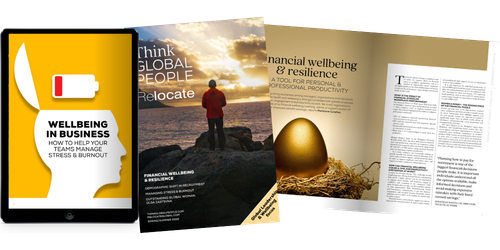
Magazine Spring / Summer Issue
Magazine
Spring / Summer Issue


In partnership with our sister site: