
Think Women
Nikita Rajgopal | 80 Outstanding Global Women 2026
Growing up in Mumbai, Nikita Rajgopal was driven by a simple ambition: to make the most of every opportunity that came her way. Raised as an only child, she worked hard, embraced new challenges, and was determined to build a career that would take her beyond the familiar. Marianne Curphey talks to her about how she became a globally mobile professional.
That childhood mindset of improvement and hard work has shaped her career. Now a Principal at L.E.K. Consulting, a global strategy consulting firm, Nikita advises clients across multiple countries on mergers and acquisitions (M&A), growth strategy, commercial and vendor diligence in the Education sector.
“The big motivator for me was always: how can we do better? How can we create more opportunities and live a better life?” she says. “That has always been a reason for me to study hard, make the most of every opportunity and keep pushing myself to grow.”
“Schools are here to stay. Technology will act as an aid to education and the curriculum, but it will not fundamentally change the way people learn.”
Nikita Rajgopal, Principal, L.E.K. Consulting
An education in technical and business skills
She completed her undergraduate engineering degree in Mumbai in India before going on to earn an MBA from the Indian School of Business (ISB), where she was among a small number of graduates recruited by global strategy consultancy L.E.K. Consulting. Over the past six years, she has progressed to the role of Principal in the firm’s Global Education Practice, where she advises investors, education providers and private equity firms on growth strategy, market expansion and investment opportunities across the international education sector.
However, her career path was not entirely predictable from her early interests. At school she particularly enjoyed languages, social sciences and mathematics. “It is very ironic because I did not end up doing anything with languages,” she says, “but I really enjoyed them.”
Initially, she studied for a Bachelor of Technology (BTech) in Electrical Engineering at Veermata Jijabai Technical Institute in India. Long before advising international education businesses, her leadership skills were developed while organising one of the university’s largest technical festivals as Joint Secretary, a role that gave her an early introduction to leadership. Managing a large student-led event taught her that leadership was about more than delivering results. It required bringing people together, communicating effectively and adapting her approach based on feedback. She says that these lessons have stayed with her throughout her career and that the experience of early leadership changed her whole approach to managing teams and people.
“I was a completely different person back then,” she says. “Leading the festival gave me my first opportunity to manage a large team and, more importantly, to receive honest feedback from my peers. It helped me understand how to communicate more effectively, work with different personalities and become a better leader.
“If you spoke to people who knew me then and compared that with who I am today, they would probably notice the difference. A lot of that growth came from that experience and from learning to listen, reflect and improve.”
Developing a career in consulting with a global reach
After university she joined Deloitte, where she gained early experience on strategy around technology and the implementation of transformation projects, including an overseas client assignment. Those formative years helped her build skills that would become central to her work. These included understanding the structure and finding ways to solve complex problems, the ability to present data clearly, understanding how to communicate effectively with senior stakeholders, and staying composed under pressure.
“It was an amazing experience because everyone on the client side really loved the output we generated,” she says. “That also gave us a lot of confidence about putting ourselves out globally.”
After completing her MBA at the Indian School of Business, Rajgopal joined L.E.K. Consulting in 2019, drawn by the firm’s international reach and entrepreneurial culture.
“It was a global business, but the practice still had the feel of a place where you could take ownership, get exposure across levels and really spread your wings,” she says. That role gave her experience in a variety of countries and sectors.
Over the past six years, she has grown from Consultant to Principal, taking on increasingly complex engagements and broader leadership responsibilities. Along the way, she has developed a particular focus on the global education sector, working with clients across North America, Europe, the Middle East and Asia.
She has also become an active contributor to L.E.K.’s thinking on global education investment, including speaking at industry forums such as the IPSEF Global Education conference and Education Investor Summit in London. For her, the appeal of the sector lies in combining rigorous strategy work with an area that has a direct impact on people’s lives.
An evolving leadership style and approach to management
Rajgopal explains that her leadership style has evolved considerably over the years.
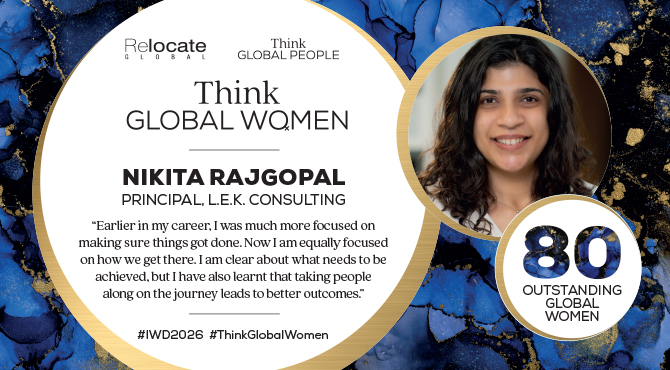
“Earlier in my career, I was much more focused on making sure things got done,” she says. “Now I am equally focused on how we get there. I am clear about what needs to be achieved, but I have also learnt that taking people along on the journey leads to better outcomes. When people feel engaged and valued, they are more motivated and they do their best work.”
Trends in education markets
As a recognised voice in the international education sector, Rajgopal regularly speaks at global conferences on the trends shaping private education. One of the biggest lessons she shares with international education providers is that successful expansion requires deep local understanding rather than assuming a model that works in one country will succeed in another. In other words, rigorous research and knowledge need to inform strategy so that the approach can be adapted to the specific country and region in which you are planning to expand.
She points to the United States as a prime example. While it remains one of the world’s largest education markets, it is also one of the most complex. There is no guarantee that just because you have a successful brand in one country, that it will easily and readily transfer or be immediately recognised in the United States. US parents also have different requirements, and their preferences can differ within the country itself.
“The regulations differ state by state,” she explains. “You need to understand what the US customer wants, and that differs state by state and county by county.”
She explains that the US is a difficult market for British brands and that schools and education groups need to do their research properly before they think about expanding there.
“Even within states there are different market dynamics,” she says. “One mistake UK education providers sometimes make is taking their UK brand into the US without adapting it for local audiences. Success comes from understanding what families in each market actually want.”
Online learning, Artificial Intelligence (AI) and the hybrid model of education
Global Education and Training Expenditure is set to reach at least $10 trillion by 2030 as population growth in developing markets fuels a massive expansion and technology drives unprecedented re-skilling and up-skilling in developed economies, according to Holon IQ. It says the next decade will see an additional 350 million post secondary graduates and nearly 800 million more K12 graduates than today. Asia and Africa are the driving force behind the expansion. L.E.K.’s own analysis of the sector Good as Gold: Resilience and Attractiveness of the Global K-12 Sector, found that there was strong demand for private education across a variety of global markets.
Rajgopal says that over the coming years, technology and artificial intelligence will reshape education, but by complementing rather than by replacing schools.
“I don’t think brick-and-mortar schools are going away,” she says. “What will change is what students learn and how technology and AI become part of that learning.”
She expects online learning to continue growing for specialist audiences, such as globally mobile families, elite athletes and learners seeking greater flexibility, but believes it will complement rather than replace traditional schools.
“Schools are here to stay,” she says. “Technology will act as an aid to education and the curriculum, but it will not fundamentally change the way people learn.”
She believes online learning platforms will continue to grow and be used by specific groups. However, mainstream schools will remain resilient.
“Online learning is suited to specific audiences, such as specialist learners, students who move frequently, or athletes in the US who need flexible academic programmes around sport,” she says. “For those kinds of propositions, online schooling is definitely growing, and growing quickly. However, we expect it to remain a niche market rather than replacing traditional brick-and-mortar schools.”
Technology and artificial intelligence will however, become part of the curriculum and will be a key element of the learning experience within schools. In addition, what students learn in school, and how they learn, is likely to change dramatically.