An Overview of Education & Schools in Japan for Expat Families
The UK joined the CPTPP trade partnership which includes Japan in 2024, boosting international trade partnerships mainly in tech, engineering and finance.
In 2025, overseas workers in Japan reached a record 2.3 million people. Japan’s ageing population requires overseas skills to fill positions. And so Japan is emerging as a welcoming destination for families relocating for work—offering stability, opportunity, and a rich cultural experience.
In this article we focus on helping families understand the education system in Japan and the options availabe for expats when choosing schools.
Thanks to a strong economy, a vibrant culture and a growing selection of highly-rated international schools, Japan has plenty to offer globally-mobile families. Government immigration figures for 2025 show a growing population with nearly four million foreign residents in Japan – most being Chinese followed by Vietnamese and South Korean.
“Japan is a buoyant and growing market fuelled by robust economic growth and healthy long term outlook”, says Sudeep Laad, partner at L.E.K Consulting and founding leader of its global education practice.
From an education perspective, Japan offers a safe, structured, and high-quality learning environment, with options that suit both short-term assignments and long-term stays. Whether you choose public schooling for cultural immersion or an international school for continuity, there are excellent choices available.
How does education in japan work?
The Japanese education system involves twelve years of schooling and, typically, four years of university. Schooling is broken up into four stages:
- Pre-primary: this stage is optional and consists of, Yochien (Kindergarten, ages 3 to 6) with an educational focus and Hoikusho (Daycare/Nursery, for younger children) which is simply childcare.
- Primary School: Shogakko (ages 6 to 12) is start of compulsory schooling.
- Lower Secondary School: Chugakko (ages 12 to 15).
- Upper Secondary School: Koko (ages 15 to 18) This is not compulsory, but almost all children go through this stage as part of their schooling.
The standard academic year is made up of three terms begining in April. This can have a big impact on families coming from countries with a September start date and parents will have to consider the merits of either keeping a child back a year, or inserting them into the equivalent stage in Japan. Schools are familiar with transfers so will support placement.
Whilst some international schools align with this structure, others do not, so it is worth checking with each school you are interested in.
- First Term (April – July): The school year begins in April, coinciding with the peak bloom of cherry blossoms, creating a visually symbolic start to the academic year.
- Second Term (September – December): Includes major events like Sports Day and school trips, with a break for the New Year.
- Third Term (January – March): Shortest term, focusing on final exams and graduation ceremonies.
Public Education in Japan
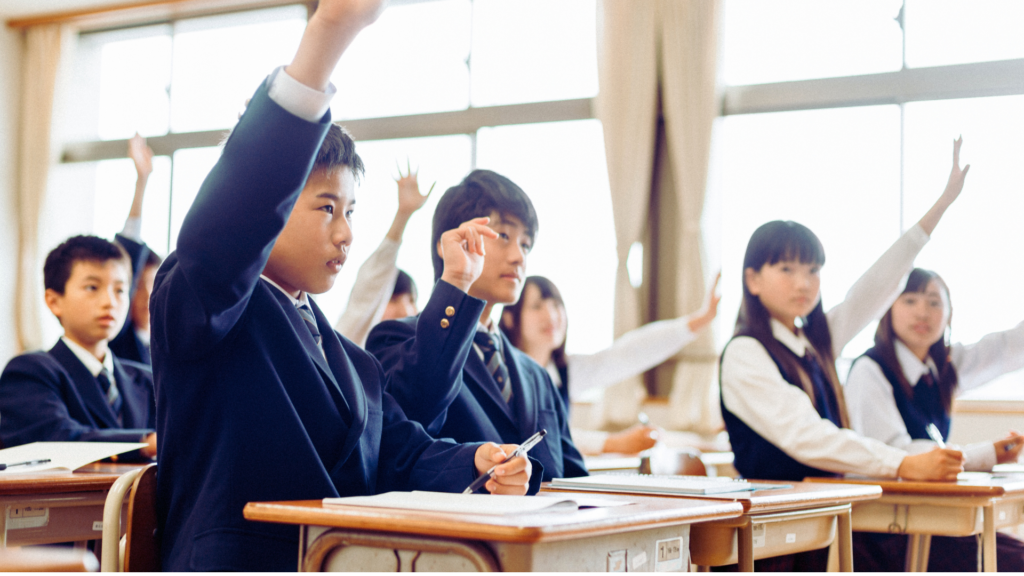
The public education system in Japan is highly regarded for its exacting standards, but tends to be highly pressurised and exam focussed. Public schools are free and open to everyone, including expats. However, all lessons are conducted in Japanese.
Standards in the public system are high: the OECD’s Programme for international Student Assessment (PISA) which compares the attainment levels of 15 year olds globally, found Japanese students scored highly, particularly in science and maths. Japanese state schools are popular with bilingual families, where one of the couple is Japanese, or those planning to stay in Japan. For most expats though, the language barrier is too hard, and their children attend an international school where lessons are taught in English.
“Expat families here for the long term may send their child to Japanese pre-school (hoikuen/yochien) and elementary school but move to an international school for secondary education,” says Kirsteen Jack, founder of the International School Advisory Tokyo.
Puclic school Japan
International schools
Most of Japan’s 80-plus international schools are based in Tokyo although there are others in larger cities such as Yokohama and Kobe. According to ISC Research there are at least 60 international schools in Tokyo delivering a range of curriculums with American and British being the most popular and many schools providing the IB (International Baccalaureate). There is a good choice of schools, including faith, single sex and bilingual, and a wide range of curriculums for a range of budgets.
Tokyo is becoming a really attractive destination educationally for international families,” says Kirsteen Jack, founder of the International School Advisory Tokyo. “The Japanese government has become open to the presence of international schools and what they can bring to Japan, and the country is starting to become an alternative to China.”
International schools are also increasingly popular with Japanese families, particularly those who are globally minded or bicultural. They are more holistic and less pressurised than public schools, something of growing importance to locals.
Tokyo – what to expect
Although most expats enjoy living in Tokyo, the city presents some challenges: the language barrier can be difficult to negotiate and accommodation is expensive. In the 2023 cost of living rankings by ECA International Tokyo comes in at number 10 in the world’s most expensive city index.
According to the 2024 expat city rankings by InterNations, a comparison of how expats rate their life in cities across the globe, Tokyo ranks towards the middle – 25 out of 53. The city rated well for quality of life but many expats felt it can be hard to settle and make friends in the city.
Tokyo International schools
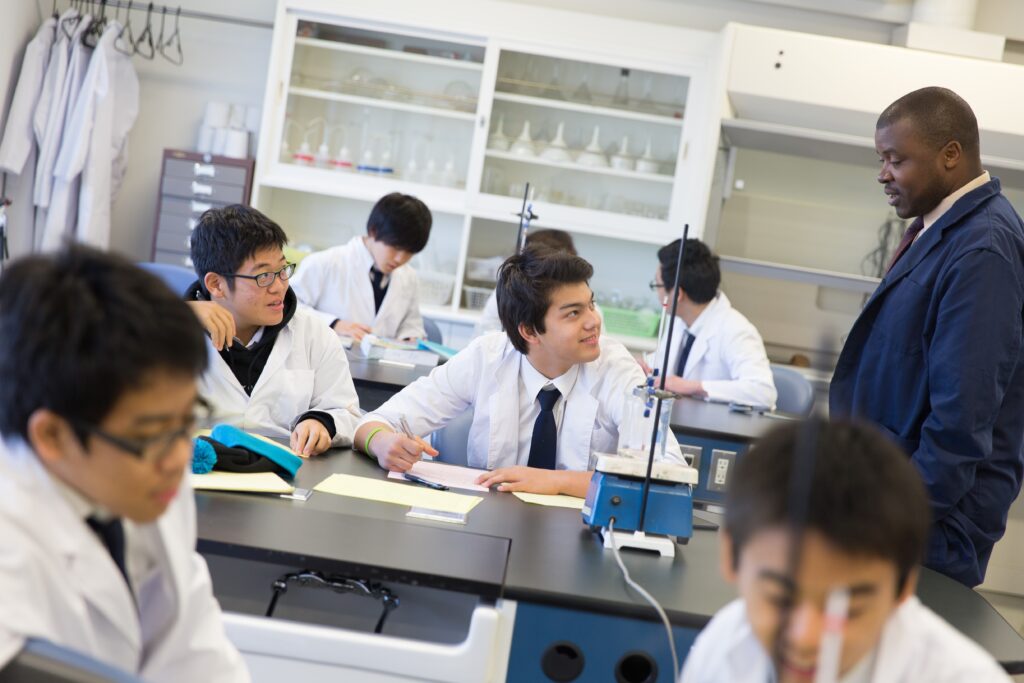
First, St. Mary’s International School was founded in 1954 by the Brothers of Christian Instruction. This school caters to boys from kindergarten to grade 12 and is situated in the Setagaya ward of Tokyo. St. Mary’s offers specialized programs tailored to meet the developmental needs of boys, including the IB Diploma Programme.
Another notable institution is the International School of the Sacred Heart, an all-girls Catholic school located in Hiroo, Tokyo. With origins dating back to 1908, the school provides bilingual education in English and Japanese to students from preschool through high school.
The American School in Japan (ASIJ), founded in 1902, is an international school situated in Tokyo. ASIJ provides education from pre-kindergarten to twelfth grade, following an American-style curriculum that includes Advanced Placement courses and the International Baccalaureate diploma programme.
Seisen International School, founded in the late 1940s, is a Catholic all-girls school. The school offers an international education with an emphasis on critical thinking, creativity and problem-solving skills.
The British School in Tokyo, founded in the late 1980s, provides a British-style education from preschool to high school. Located in central Tokyo, it adheres to the National Curriculum of England and Wales, offering GCSE, A-level, and the International Baccalaureate (IB) programme.
St. Mary International School Tokyo
Additionally, there are several well-established schools in the region:
Tsukuba International School (TIS), established in the early 1990s in Tsukuba City, a renowned international and science city near Tokyo, is a private, non-profit educational institution. TIS offers an international curriculum from pre-kindergarten to grade 12, focusing on English language proficiency, cultural understanding, and critical thinking skills.
KOBE schools
In the Kobe region, a residential location is also suitable for those working in Osaka, the longest standing schools include the Canadian Academy. This is a prestigious international school and it follows the IB curriculum, emphasising critical thinking, communication, and global citizenship. With a diverse student body representing various nationalities, the Canadian Academy fosters a supportive and inclusive learning environment.
Marist Brothers International School is a co-educational Catholic school offering education from kindergarten to grade 12. The School focuses on developing critical thinking, creativity, and leadership skills. With a diverse student body representing numerous nationalities, Marist Brothers School provides a supportive and inclusive learning environment.
Language and Culture Options
Most offer education in English but there are options for different nationalities including the Lycee Francais International de Tokyo (French); the Deutsche Schule Tokyo Yokohama (German); the India International School in Japan, created in 2004 and about to move to new campus in the Koto area, and the Tokyo Chinese School which follows the curriculum of the Republic of China.
There has also been a surge in demand for Tokyo’s international schools from Chinese nationals: Traditionally Chinese students would have been sent to board in the UK but Japan offers a closer alternative, geographically and culturally.
“Chinese expats account for between 40 and 50 per cent of all expats in Tokyo. As the provision of international schools shrinks in China due to regulatory pressure, the demand is being met elsewhere,” says L.E.K’s Sudeep Laad.
Newly opened International Schools In japan
The last few years have seen a mini construction boom in international schools in the city and three offshoots of branded UK private schools have opened in the last few years: Harrow International School Appi Japan in 2022 in the Appi mountains and Rugby School Japan and Malvern College Tokyo both opening in September 2023. The British School in Tokyo opened a new campus in Tokyo in 2023 to cope with increased demand.
“Existing schools are running at high capacity indicating a favourable outlook for these new schools,” says L.E.K’s Sudeep. “It is also expected more British school brands will turn to the Japanese market to address the high growth in demand.”
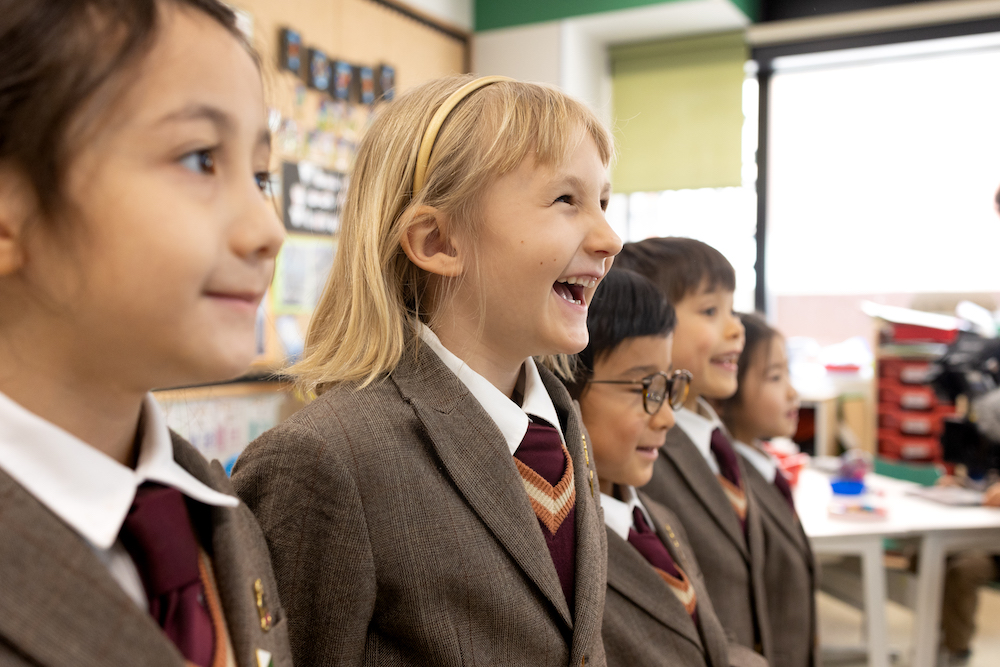
Phoenix House International School
Other new schools include the Hakuba International School, founded by a former Goldman Sachs banker, opened in 2024 with a curriculum focused on outdoor learning and sustainability. The boarding school is set amongst nature in the beautiful Hakuba Valley with a focus on the environment and personal well-being.
Jinseki International School opened in 2020 in Hiroshima, Japan’s first full boarding primary school with bilingual learning in English and Japanese and the Capital Tokyo International School opened last year with a focus on bilingual education. Students are mainly taught in English with some lessons in Japanese and weekly Mandarin Chinese lessons.
Key points for families to consider
-
- Plan early
International schools in Tokyo often operate at high capacity—apply well in advance. - Language matters
Public schools teach in Japanese. International schools offer English and other language options. Younger children pick up basic conversational Japanese within about six months. Academic reading and writing often takes longer, commonly 2–3 years to fully catch up depending on age. For older chldren, language tutoring may be needed. Even short-term exposure to Japanese schooling can give your child valuable cultural and language skills. - Curriculum choices
IB, British, and American programs are widely available, plus bilingual and faith-based options. - Costs vary
Public schools are mainly free with some costs to cover lunches, supplies and materials, and (generally affordable) school trips. International school fees differ significantly and include a fairly high tuition fee, facility fee, technology and textbooks, trips and extra-curriculars—budget accordingly! - Cultural opportunity
Japanese schools often emphasize group responsibility, strict punctuality, and rules around uniforms (no make-up or specific hairstyles) and behavior. Learning the school handbook early helps children avoid accidental rule-breaking and reduces culture shock. - Chores in school!
Students in public schools clean their classrooms and school daily, teaching responsibility, team work, respect for shared spaces, and humility. International schools incorporate this to varying degrees. - Holiday homework
Summer break is usually around six weeks. Be aware that it is common for children to have homework assignments like research projects, book reports and maths drills to work on during the break. This is true in both public schools and international schools. - The school day
Japanese schools typically start around 8:30-8:45 AM, with classes (45-50 mins each) running until about 3:00 PM, followed by cleaning and then extensive after-school club activities (sports, culture) or juku (cram school), meaning many students are busy until 6:00 PM or later, though younger students often finish earlier after lunch.
- Plan early
Despite the many advantages of living in Japan, there are certain challenges that expats may face. One such challenge is the difficulty of learning the local language, making it challenging to navigate daily life without proficiency in Japanese. This makes an international school education decidedly easier for expat families, and offers the benefit to parents of building a network of overseas friends, which can help navigate the less familiar part of Japanese culture and systems.
In summary, for those who are able to overcome cultural challenges, Japan is a safe, comfortable and stimulating destination for relocation and offers a rich educational journey for expat families.