A Guide to Schools and Education in Singapore for Expat Families
Relocating to Singapore with children brings many advantages, not least access to one of the world’s most respected education systems. Consistently ranked among the top global performers, Singapore offers high-achieving local schools and a thriving international school sector tailored to expatriate families. From British and American curricula to the International Baccalaureate and bilingual programmes, parents are faced with an impressive, if sometimes overwhelming, choice.
This guide explores how the education system works in Singapore, what schooling options are available to expats, and the key factors to consider when choosing the right school for your child.
How Does the Education System Work in Singapore?
Singapore’s education system is widely regarded as one of the strongest in the world. Government schools are overseen by the Ministry of Education (MOE) and are known for their academic rigour, consistently achieving top results in international assessments such as the Programme for International Student Assessment (PISA).
However, the local education system is only one part of the picture. For expatriate families, Singapore is also home to one of the largest and most established international school markets globally, offering a wide choice of curricula, facilities and fee levels.
Are Local Schools an Option for Expats?
In practice, local government schools are rarely an option for expatriate families. Singaporean citizens and permanent residents are given priority for places and competition is intense. In addition, Singaporean students are generally required to attend government schools rather than international schools.
While it is technically possible for expatriate children to gain admission to local schools, places are limited and difficult to secure, making international schools the most realistic and popular option for expat families.
Key Factors When Choosing a School
With so many options available, choosing the right school in Singapore depends on several key factors:
- Curriculum and university pathways
- School reputation and brand
- Fees
- Facilities and extracurricular offerings
- Location and commute
Families often select schools based on where their children are likely to study in the future (UK, US, Australia or Asia).
Long-established and well-known schools tend to be in highest demand.
– Schools generally fall into three tiers:
– Super-premium: SGD $40,000+ per year
– Premium: SGD $25,000–40,000
– Mid-market/budget: SGD $15,000–25,000
Sports, performing arts, outdoor learning and specialist programmes are increasingly important.
Singapore is compact, but daily travel time still matters.
International Schools in Singapore
Singapore has a mature and highly competitive international school market, with around 50 international schools educating approximately 60,000 students. These schools operate independently, can offer a wide range of curricula, and are primarily attended by expatriate children, as local students require special permission from the MOE to enrol.
Most international schools in Singapore are:
- Co-educational
- Through-train (early years to age 18)
- Large in scale, often enrolling 2,000–4,000 students
- Home to diverse, multinational student bodies
- Equipped with outstanding facilities, including sports complexes, performing arts centres and specialist learning spaces
Growth in the sector remains strong. International school numbers have increased significantly in recent years, with capacity carefully regulated by Singapore’s Economic Development Board (EDB), which releases land for new schools when required.
The super-premium sector, including schools like Chatsworth International School, Tanglin Trust, XCL American Academy, XCL World Academy, United World College (UWC) and North London Collegiate School Singapore (NLCS) are highly sought after and often come with lengthy waiting lists. “As long as the supply and demand doesn’t change significantly that situation is likely to persist,” says Goel.
The United World College of South East Asia is a well-established and popular school with two campuses, the original Dover Street campus which opened in 1975 and the East campus which opened in 2008. The school belongs to a family of 18 UWC on four continents which aim to “make education a force to unite people, nations and cultures for peace and a sustainable future.” The interdisciplinary curriculum culminates in the IB Diploma.
UWC prepares its students for life anywhere in the world with a huge focus on community, extra curricular activities and personal development. I’d encourage anyone to send their kids there.”
Former Singapore Expat
Chatsworth International School is known for its inclusive ethos and strong focus on academic and personal development. Offering a through-train education from early years to age 18, the school follows the International Baccalaureate framework, with the Primary Years Programme (PYP), Middle Years Programme (MYP) and Diploma Programme (DP). Chatsworth attracts a diverse international student body and is particularly valued by families seeking a supportive learning environment with a strong emphasis on pastoral care, creativity and global citizenship.
Explore Our Featured Schools in Singapore


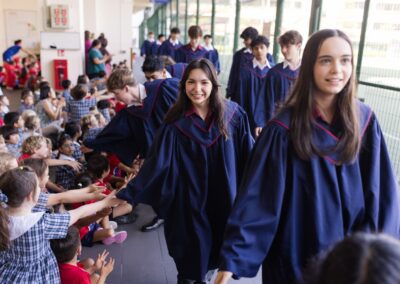
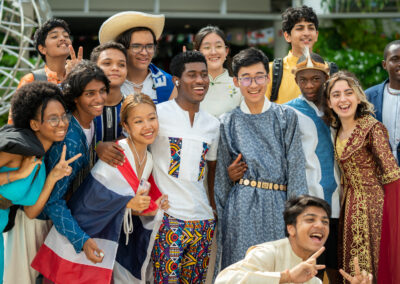
“Many international schools, particularly those charging premium fees, are reporting an increase in student numbers,” says Janelle Torres, research manager for South-East Asia at ISC Research.
“Singapore is different to some other expat markets such as Dubai where people tend to stay for seven or eight years,” says L.E.K’s Goel. “In Singapore, most stay for three and four years, which means schools constantly have to replenish their student numbers.”
Parents are looking for increasingly sophisticated offerings. “Schools need to innovate to stay competitive,” says ISC Research’s Torres. “Outdoor spaces are increasingly popular and the addition of Mandarin is a trend due to the influx of expatriates coming from Chinese-speaking countries. There is also a growing emphasis on specialised extracurricular activities.”
What Curricula Are on Offer?
One of Singapore’s biggest attractions for expat families is the breadth of curricula available. Options include:
- British (English National Curriculum, IGCSEs, A levels)
- International Baccalaureate (IB)
- American curriculum and High School Diploma
- Canadian
- Australian
- German, French, Dutch and Japanese systems
- Chinese and Mandarin-focused programmes
English is the primary language of instruction in most schools, but bilingual education is increasingly popular, particularly English–Mandarin programmes. The IB is the most widely offered curriculum in Singapore, reflecting the international nature of the student population and its global university recognition.
British Schools in Singapore
British schools play a major role in Singapore’s international education landscape, with around 40% of international schools offering some form of British curriculum.
Notable British schools include:
Tanglin Trust School – The popular and well respected Tanglin Trust is the oldest British school in Southeast Asia. Opened in 1925, it celebrated its centenary in 2025. It educates 2800 students and offers the English National Curriculum, IGCSEs, and uniquely in Singapore, a choice of A levels or the IB Diploma in sixth form.
The new Tanglin Centenary Building opened in 2023 housing impressive new facilities which include a 50-metre swimming pool, physio and fitness facilities, a gymnastic centre, music room and a personal learning and development centre.
Tanglin is an excellent school. Nurturing, great facilities and strong academic results.”
London Expat living in Singapore
In 2025 it opened an learning centre in Gippsland, Australia, introducing the Highlands Programme where year 9 pupils attend a five week learning experience. It is highly academic, extremely popular, and known for long waiting lists.
Dulwich College (Singapore) – was the first British school “brand” to open in 2014 and now operates a popular and highly rated through-train school educating 2600 children aged between 2 and 18 years. Students follow an enhanced version of the English National Curriculum and take IGCSE exams followed by the IB Diploma or IB Career Related Pathway in the sixth form.
North London Collegiate School (NLCS) Singapore – NLCS already has schools in Dubai and South Korea and follows an inquiry-based curriculum leading to IB in the sixth form. The purpose built campus in Queenstown has impressive facilities including a 50 metre swimming pool, performing arts centre, gym, two libraries, roof gardens and new science and tech facilities.
Brighton College (Singapore) – also opened in 2020, to deliver a British pre-prep and prep-school education from pre-nursery to year 9. In 2024, it added a secondary school offering IGCSE and A levels. The school is situated on a sprawling campus which also houses the Australian International School and the Stamford American International School (SAIS).
Wellington College – opened in January 2025 on a new campus in Bukit Timah. Wellington already has eight international schools including in China, Thailand and India and will enrol 2000 students and offer an English curriculum followed by the IB Diploma.
The Perse School – will initially open a primary school for 3-11 year olds, extending to 11-18 years olds from 2026, with IGCSE exams followed by IB Diploma. The school’s new campus, a redevelopment of an existing school on Chestnut Drive, is 20 mins from the CBD.
Investment in Facilities: New Campuses and Modern Learning Spaces
In addition to new schools, there has been a series of impressive renovations in recent years. The Overseas Family School follows the International Primary Curriculum followed by the IB and moved to a new campus with impressive facilities in 2015, with capacity for 4800 students.
Four years ago Nexus International School moved to a new high-tech campus in 2020 and educates 1500 students from early years through to the IB Diploma. The new purpose-built campus is based around innovative open plan learning spaces which allow students to be flexible in their learning. Design and technology rooms can be found in most learning hubs to integrate STEAM into lessons and the new campus also includes an Olympic sized pool, FIFA and World Rugby specified AstroTurf pitches and a two-tier theatre.
Bilingual Schools in Singapore
Bilingual education is one of the fastest-growing segments of Singapore’s international school market. Mandarin-English programmes are particularly popular due to Singapore’s location, business environment, and growing number of families from Chinese-speaking backgrounds.
Well-regarded bilingual schools include:
The Canadian International School (CIS), established in 1990 is an IB school for 3000 students, its Chinese-English bilingual programme is highly rated.
The German European School (GESS), founded was 1971 by a group of German parents. It offers the German leaving certificate alongside the IB. German is the primary language of instruction and the second official language in the IB programme.
Dulwich College , Singapore American School and XCL World Academy – All offer bilingual pathways or immersion options.
More affordable bilingual schools are also expanding, making this type of education accessible to a wider range of families.
American Schools in Singapore
The American system is also well catered for in Singapore. The expansive Singapore American school (SAS), educates 4000 students from nursery to 18 years on a 36-acre campus. Opened in 1956, it is undergoing a huge upgrade to include two new swimming pools, an athletics track, new elementary and middle schools and facilities for arts, technology.
At the Cognita group’s Stamford American International School (SAIS), students take either the IB Diploma or the American High School Diploma. Opened in 2009, it takes students from two months in its infant care programme in the specialist Early Learning Village which runs a Reggio-Emilia inspired programme. The elementary and secondary schools are housed on the separate Woodleigh campus for 6 to 18 year olds.
In most premium schools there are often lengthy waiting lists. Schools in Singapore usually offer a rolling admissions process, meaning if a space is available it can be taken, regardless of the time of year.
Five Things Families Need to Know About the School Day in Singapore
- School starts early
- Breaks and lunchtimes are standard
- Most kids get the bus to school
- Homework is a regular part of school life
- After-school activities (CCAs) are an important part of the day
School hours vary by school and age group, but most primary and secondary students attend school from early morning to mid-afternoon, with some schools starting as early as 7:30am and others offering early care or later finishes for activities.
Breaks and lunchtimes are built into the day, with a morning recess and a supervised lunch break (usually 30–60 minutes), where students eat in canteens or classrooms and are encouraged to bring or choose healthy food.
School buses are widely used, particularly by international schools, with organised pick-up and drop-off times, though routes, fees and availability vary and often need to be arranged well in advance.
Homework increases with age, and typically focuses on reinforcing learning, so families benefit from setting a consistent after-school homework routine.
Activities take place after lessons and sometimes being compulsory, meaning some students finish later and require adjusted transport plans.
How Hard Is It to Get a Place?
Competition for places can be intense, particularly at well-established premium schools. Many of the most sought-after schools operate waiting lists, especially for popular entry points.
That said, most international schools in Singapore use a rolling admissions system, meaning students can join at any point in the academic year if a place becomes available. Flexibility in start dates, year groups or curriculum choices can improve the chances of securing a place.