Inside the Arbor School, Dubai: Where Academic Excellence Meets World-Leading Environmental Education
Located in Al Furjan, Dubai, the Arbor School is a British-curriculum school educating around 1015 students from more than 90 nationalities.
What makes Arbor exceptional is its commitment to embedding eco-literacy and environmental education into everyday classroom experiences from FS1 right up to Year 13. The Arbor School earned global recognition for their approach when it was named the winner of the World’s Best School Prize for Environmental Action in 2025.
At Arbor eco-literacy shapes a learning experience where hands-on projects link directly to real environmental challenges, encouraging students to think critically and creatively.
The skills developed through eco-literacy also contribute directly to their strong academic outcomes. In a recent webinar, The Arbor School: How a Dubai School Became the World’s Best for Environmental Action, Principal Gemma Thornley told Think Global People that the school’s excellent GCSE and A Level results stem from its emphasis on critical thinking and purposeful, eco-driven learning.
“Our students achieve exceptional GCSE and A Level results. I genuinely believe it’s because we’re giving them the skill set, the opportunities to be critical thinkers, to think outside the box, to have a voice, and to look at things from a different perspective”
In this article we explore how Arbor has become a shining example of what other schools are trying and often failing to achieve: the seamless merging of rigorous academic standards with practical environmental learning.
How a Dubai School Embeds Eco-literacy Within a Traditional British Curriculum
Underpinning the more traditional British curriculum lies a bespoke “ecoliteracy programme,” spanning from Foundation Stage all the way through to post 16, Eco-literacy is not considered as a standalone subject, but as a guiding lens for the entire curriculum.
Thornley described it in the webinar as “a broad umbrella of ecological and environmental education… a lens that sits over everything we do.”
Rather than teaching sustainability in isolation, Arbor looks for opportunities to replace more traditional content from the British curriculum with hands-on, enquiry-led learning rooted in real environmental challenges.
“We look for places where something in the UK curriculum might feel a bit dry,” Thornley explained, “and swap it for something more meaningful, more connected to the world the students actually live in.”
This eco-literacy thread evolves as students move through the school. In the Foundation Stage, the focus is on sensory, play-based exploration, learning by touching soil, observing insects, and spending extended time outdoors. Children begin to build a relationship with the natural world simply by being in it. “For our youngest learners, it’s about getting their hands dirty and discovering what nature looks and feels like,” Thornley explains.
In Primary, eco-literacy becomes more structured and conceptual. For example, Year 3 students explore The Tin Forest, using the story as a springboard to discuss waste, biodiversity, and human impact on natural environments. These lessons unfold through a project-based, enquiry-driven model that resembles elements of IB teaching while still anchored in the British curriculum. Students investigate problems, propose solutions, and connect literature, science and ethics in a way traditional schemes of work rarely allow.
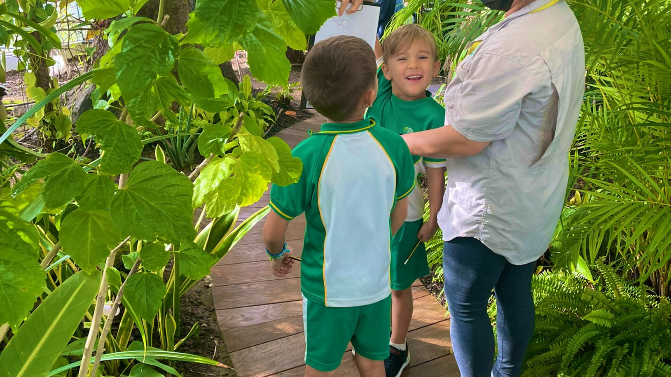
In Key Stages 4 and 5, eco-literacy shifts toward advocacy, global citizenship and academic depth. All students at this level complete the Global Perspectives GCSE, which Arbor has made a mandatory additional qualification. The school has also designed its own Global Impact Certificate, blending environmental action with pastoral and academic development. In Sixth Form, this evolves into an Extended Project Qualification (EPQ), giving students the chance to turn their ecological enquiry into a formal qualification recognised by universities.
Across every phase, Arbor’s message remains consistent: environmental understanding is not added to learning, it drives it. As Thornley summarised, “It’s a thread that runs through everything we do, enriched by ecological and ethical enquiry from our smallest learners to our exam students.”
The Arts, Outdoor Learning and Student Voice: Empowering Arbour’s Young People
For Principal Gemma Thornley, the arts are not an add-on at the Arbor School, they are central to shaping confident, articulate young people who can drive environmental change. As she explained in the webinar, her own background in performing arts plays a powerful role in how she leads the school’s eco-literacy mission.
“If you’re challenging these students to be changemakers for tomorrow, they need a voice. They need to be able to articulate themselves, to stand up and be counted,” she said.


Thornley believes that throughout history, the arts have helped societies confront injustice, amplify unheard voices and inspire collective action. This belief threads directly into the Arbor School’s ethos: environmental responsibility is not only scientific and practical, it is expressive and creative.
Fine art, sculpture, drama, music and dance all become tools for environmental storytelling, helping students engage emotionally with global issues and communicate their ideas with clarity.
Sport plays a similarly important role. “You’re wanting students to have healthy minds,” Thornley said. “They need that physical attribute as well.” The school has recently reimagined its PE provision with the appointment of its first outdoor educator, “our very own Bear Grylls,” as she describes him. His mission is to integrate outdoor learning into physical education.
“If you are doing geography and studying rocks, why not get on a kayak and go and look at the geological makeup around the coastline?” she explains
This innovative approach shows the school’s commitment to blurring the boundaries between subjects.
Through this integrated mode, where arts, outdoor education, physical health and eco-literacy support one another, the Arbor School prepares young people not only to excel academically but to lead with imagination and purpose.
What’s Next for the Arbor School?
Looking ahead, Principal Gemma Thornley sees the Arbor School playing a leading role not only within Dubai, but across the UAE’s wider sustainability landscape. As she explained in the webinar, the school’s mission “enough for all, forever” aligns closely with the UAE’s national direction on sustainability, innovation and climate action.
“We want to be a beacon here,” Thornley said. “To lead the way for other schools in what really strong environmental education can look like… everyone has the opportunity to do something.”
She emphasised that while not every school has access to the same facilities, every education setting can integrate environmental learning in meaningful ways. Arbor hopes to help shape that movement especially in Dubai, supporting the UAE’s Vision 2030, which positions education as central to climate resilience.
“It’s an exciting time,” she added. “It’s a great place to be for education and for environmental education specifically.”
Building on the Prize and Inspiring Future Environmental Leaders
As a relatively new head, Thornley is focused on sustaining the high standards that helped the Arbor School win the World’s Best School Prize for Environmental Action. Her approach is rooted firmly in research and evidence.
“We’re very research-driven here,” she explained. “Everything is evidence-informed. We look closely at what really decent teaching and learning looks like.”
For Thornley, continuing the school’s success means ensuring that every decision is grounded in best practice and that every student regardless of background or learning barriers is supported to thrive.
“For me, as a head teacher, it’s a duty of care,” she said. “I want every child who walks through the door to feel supported and to flourish.”
With this commitment to research, inclusion and excellence, Thornley aims to continue empowering young people not only to understand environmental challenges, but to lead the way in solving them.
Watch the webinar : The Arbor School, DUBAI
The Arbor School stands as a powerful example of educational innovation, where sustainability strengthens academic achievement and young people are equipped to thrive as global citizens.
With its research-driven approach and unwavering commitment to eco-literacy, the school is not only transforming learning in Dubai but helping set a new global standard for environmental education.